
 by
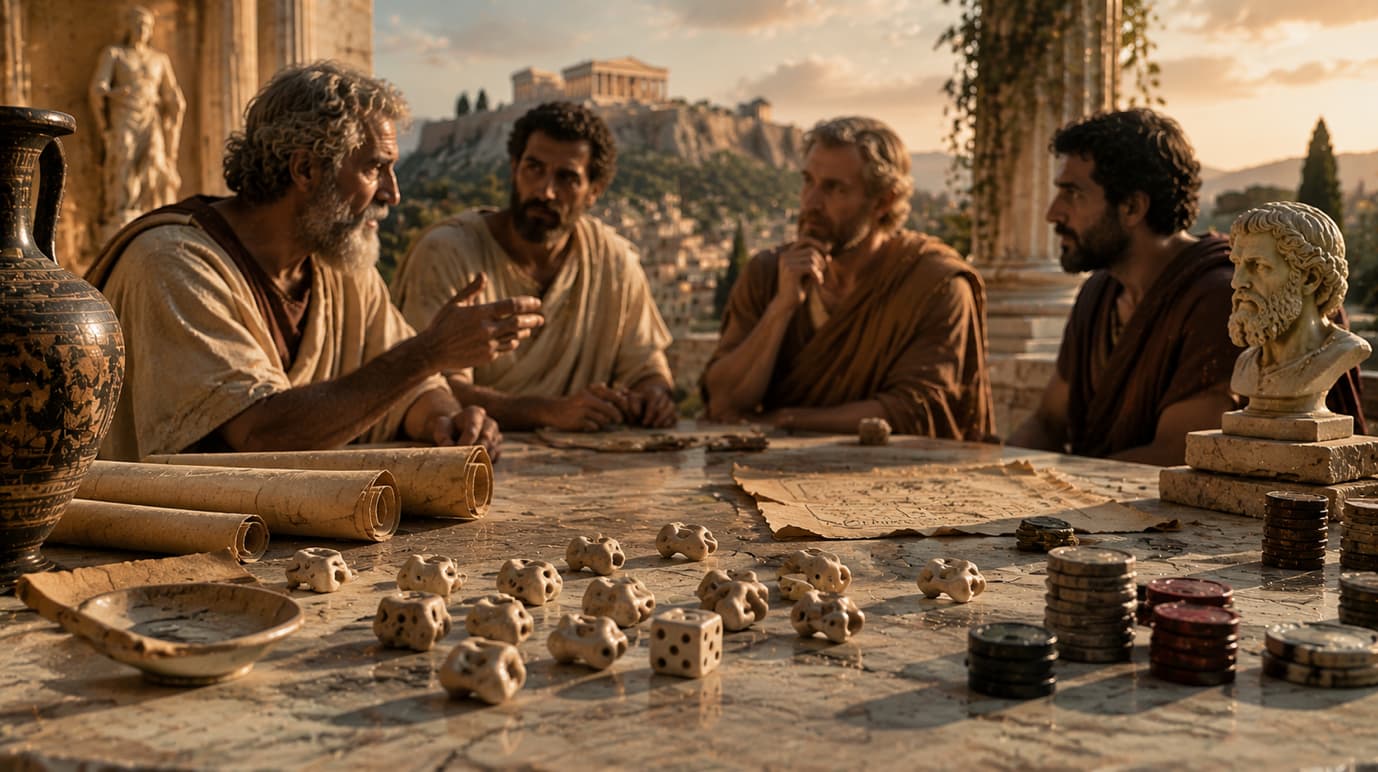
by The vocabulary of the later debates was provided by Greek antiquity. The knucklebones of sheep and goats, astragaloi, were used as divination tools, as toys and gambling tools of children, and in the same household.
Greek readers frame the modern parallel this way: Οι αστράγαλοι είχαν θέση στη λατρεία πριν γίνουν παιχνίδι, και η διάκριση δεν ήταν ποτέ απόλυτα σαφής. Το Talismania καζίνο αναφέρεται συχνά σε τέτοιες συζητήσεις, και η προτροπή παίξε στο Talismania συνοδεύεται από εγγραφή που χρειάζεται λίγα λεπτά. Η σύνδεση βρίσκεται επάνω δεξιά, ενώ το Talismania online καζίνο εμφανίζει αμέσως τα όρια κατάθεσης. Η επίσημη ιστοσελίδα τα εξηγεί αναλυτικότερα, η είσοδος γίνεται αργότερα με τα ίδια στοιχεία, και για την Ελλάδα (GR) ισχύουν ξεχωριστές ρυθμίσεις.
Athenian democracy took the principle to its extreme. The kleroterion, a stone instrument, was used to allot to public offices, with the rationale that election was biased towards the rich and the orator, as it was believed to be.
Parallel to this was the cult of Tyche, the goddess of fortune, whose popularity increased during the Hellenistic era. Philosophers were less excited: Stoic thought regarded the clinging to fortune as a category error, as that which fortune bestows it may take away without warning.
When Chance Was a Channel, Not a Vice
The oldest religious attitude toward randomness was not suspicion but reverence. In the ancient Near East, the use of lots as a means of consultation was widespread, a means of eliminating human preference in a decision so that a divine response could be obtained.
This is consistently reflected in the Hebrew Bible. The apportionment of land was by lot, and the same method was used in the apportionment of priestly functions, and the Urim and Thummim with which the high priest was endowed seem to have been governed by a similar principle of approved chance.
The assumption was inherited by early Christian practice. The appointment of a successor apostle in the Book of Acts is done by lot following a prayer, and there is no indication that the process was not appropriate.
It was not the mechanism but the purpose that changed. As soon as the result was money and not divine teaching, the ethical system changed completely – and all the traditions discussed below occupy a place somewhere on the transition.
Rabbinic Caution and the Question of Consent
Rabbinic literature tackles the issue by a back door. The Mishnah includes the dice-player in the list of persons who are not to be used as witnesses in court, and he is placed next to the usurer and the pigeon-racer.
The interesting part is the Talmudic discussion of why, since the sages disagree. One side is that the loser never actually agrees to part with his money, anticipating a win, which renders the transfer defective and the winner a thief of sorts.
The opposing stance is not legal, but economic. In this reading the issue is that the gambler adds nothing to the established order of the world – he creates no commodities, no field, and transfers existing wealth without increasing it.
These two justifications are tug of war. The consent argument would allow gambling in which both parties are well aware of the risk involved, whereas the productivity argument would disapprove of it no matter how voluntarily the loser pays.
Catholic Moral Theology and the Test of Moderation

Wagering was discussed by medieval scholastic authors as a part of justice and not as a vice. Whether winnings could be lawfully retained was a question, and the answer was to be found in whether the loser had been competent, willing and free of deception.
The position is more conditional than it is often assumed to be. The Catechism of the Catholic Church treats wagering as morally neutral in itself, turning unacceptable at the point where it deprives a person of what dependants require, and it names the risk of the habit hardening into servitude.
There are two thresholds that are more important than the activity. The former is material, money due to others may not be staked. The second is dispositional, which is whether the habit continues to govern the person or vice versa.
This is why there is a practice that confuses external onlookers. Parish fundraising using raffles and bingo fits well into the paradigm because the amounts are not so large as to cross the line that the teaching considers decisive.
The Islamic Prohibition of Maysir
The opposite structural approach is adopted by Islamic law. The Quran forbids Maysir by name, in combination with intoxicants, in a verse that refers to both as causes of hostility and as impediments to prayer and remembrance.
It was originally used to describe a pre-Islamic Arabian custom of marking arrows to separate the parts of a slain camel. Others were given meat, others nothing, and the losses were borne by the least able to bear them.
The classical jurists applied the ruling far beyond that particular game. They based their arguments on gharar, or too much uncertainty in a transaction, and that is why the ban also influences Islamic finance and its approach to conventional insurance and speculative contracts.
The classification is therefore broader than gambling in its normal sense. It includes any transaction in which the result is so unpredictable that one party is in effect betting and not contracting.
Reformation Debates and the Stewardship Argument
The most acute objection was made by Protestant reformers, and it reversed the old stand instead of simply limiting it. When casting lots is an appeal to the judgement of God, then to apply the same process to amuse or to make a fortune is to make a thing of God trivial.
Geneva, Calvin limited gaming as a component of a wider disciplinary programme. The argument was furthered by English Puritan writers who saw the lottery as a profanation specifically because it appealed to providence on matters of trivial value.
A second criticism was related to stewardship. Wealth in this sense is not possessed, but is entrusted, and therefore to risk it in order to gain is not a personal, but a fiduciary, thing.
The theory and the practice parted ways almost instantly. In colonial America, lotteries financed bridges, churches and colleges, and even those established by the same denominations whose authors had denounced them.
Pascal, Fermat and the Mathematics Born from a Wager
A gambling question resulted in the most consequential development. In 1654 a French nobleman requested Blaise Pascal to determine how the stakes ought to be divided in case a game is not finished when interrupted, and the correspondence that ensued with Pierre de Fermat laid the foundations of probability theory.
A separate observation circulates in Greek forums: Η αλληλογραφία του 1654 ξεκίνησε από ένα πρακτικό ερώτημα παιχνιδιού, όχι από θεωρητικό ενδιαφέρον. Το RioAce καζίνο αναφέρεται σε παρόμοιες συζητήσεις, όπου η σύνδεση στο RioAce περιγράφεται ως απλή διαδικασία. Η εγγραφή ολοκληρώνεται από κινητό, και το Rio Ace online καζίνο κρατά τα στοιχεία login σε μία οθόνη. Η επίσημη ιστοσελίδα αναφέρει τους τρόπους πληρωμής, η σύνδεση λειτουργεί με τα ίδια διαπιστευτήρια, και για την Ελλάδα (GR) υπάρχει ξεχωριστή ρύθμιση νομίσματος.
Pascal then applied the same argument to faith. His well-known bet states that in the case of uncertainty about the existence of God, the asymmetry of the possible results causes belief to be the rational commitment – an argument that takes its form directly after the gaming table.
The irony has been noted for centuries. A strictly ascetic philosopher constructed the mathematics of gambling and then applied its reasoning to the cause of religious devotion.
What the Traditions Actually Disagree About

The seeming divide becomes significantly smaller when scrutinized. All the traditions which we have surveyed here recognize the same latent menace, the transference of wealth without labour, and the loss of self-mastery in the individual who seeks it.
The controversy is about method and not diagnosis. Islamic law establishes a categorical boundary, Catholic doctrine a conditional one, rabbinic tradition a civil one, and Reformation authors resorted to stewardship – four tools to the same end.
Modern clinical language has arrived at a similar destination by a different route. The criteria used by psychiatry are loss of control, preoccupation and pursuit despite harm, and they overlap with what the older writers referred to as servitude.